AI Exposure of the US Job Market – Inspired by Andrej Karpathy
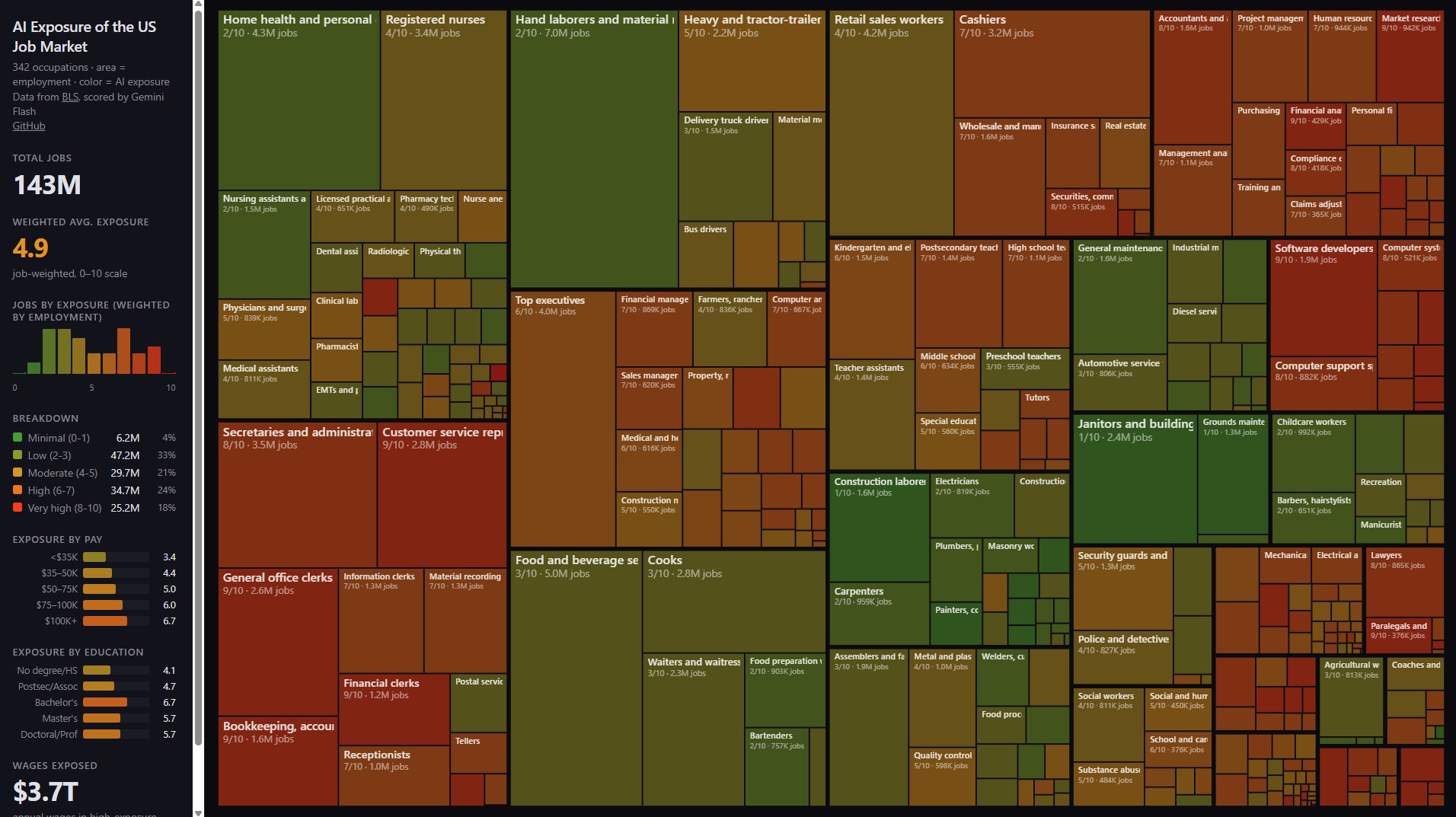
In mid-March 2026, Andrej Karpathy introduced a groundbreaking approach to scoring the US job market's vulnerability and synergy with artificial intelligence. By creating a program that scrapes the Bureau of Labor Statistics (BLS), Karpathy provided a framework to score 342 occupations covering over 143 million jobs. This application brings that vision to life, tabulating and visualizing the raw data into an intuitive, interactive dashboard.
🧠 The Karpathy Approach
The methodology is simple yet profound: parse and extract meaningful job descriptions per occupation, then use LLMs (specifically Gemini Flash) to score them based on current AI capabilities. The result is a weighted exposure scale from 0 to 10 that provides a "weather map" for the future of work.
🚀 Tech Stack & Data
- Visionary Logic: Based on Andrej Karpathy's BLS scoring script
- Framework: Next.js (deployed via Vercel)
- Scoring Engine: Gemini 1.5 Flash (scoring the BLS dataset)
- Data Source: BLS 2024/2025 occupation and wage statistics
- Visuals: D3.js treemaps with employment-weighted area sizing
🎨 UI/UX Highlights
- Macro-to-Micro View: Users can see the entire US economy ($3.7T in exposed wages) at a glance, then drill down into specific roles like "Hand laborers" or "Software Developers."
- Color-Coded Risk: High-exposure "Red" zones (8-10/10) identify sectors ripe for automation, while "Green" zones highlight physical, AI-resistant labor.
- Demographic Breakdowns: Instant side-panels showing how exposure scales with education level and annual pay.
📊 Notable Insights
As Karpathy’s scoring reveals, the "AI exposure" isn't uniform. While manual labor (Hand laborers) remains at a low 2/10 due to physical complexity, high-skill roles like software engineering are seeing scores of 9/10, indicating a massive shift in how we define "safe" career paths.
🔗 Live Demo: https://job-ratenew.vercel.app
📂 GitHub Repo: http://github.com/alecbideri/job_rate
By combining Karpathy's analytical rigor with modern web visualization, this project offers a transparent look at the evolving relationship between human labor and machine intelligence.